
Last updated 20 November 2026
The engineering log.
What we did, what it taught us and what comes next, dated as it happens. Real milestones only: anything that has not happened yet is marked as planned.
Where we are.
Lumistep is in engineering development. Hardware, Lumi OS and the app are in active development, and field trials with blind participants begin in February 2027.
- Brand and design systemDone, November 2026
- Industrial designDone, November 2026
- Engineering prototypesIn progress
- Lumi OS and the appIn development
- Field trialsPlanned, February 2027
- CertificationPlanned, mid 2027
- First production kitsPlanned, late 2027
The log, newest first.
Each entry is something that actually happened: what we did, what we learned, and what we are doing about it.
· Software
Lumi OS and the Lumistep app in development
In progress
- What we did
- Set out what Lumi OS does on the cane, glasses and buds, and what the app does on the phone. Every feature carries an honest label: Read, Find and Walk with Lumi work offline; Ask Lumi and calling a helper need internet. Development of both is under way.
- What we learned
- Offline speech in South Asian languages is the hardest part of the app. Open speech models for Bangla have improved sharply on read speech[82], but dialects are still hard[83]. So, offline, Lumi listens for a small set of commands and reads back what it heard.
- What’s next
- Bring Lumi OS up on the engineering prototypes, then test the buzz language and spoken prompts with blind participants from February 2027.
· Industrial design
Cane controls: a guarded thumb pad
Done
- What we did
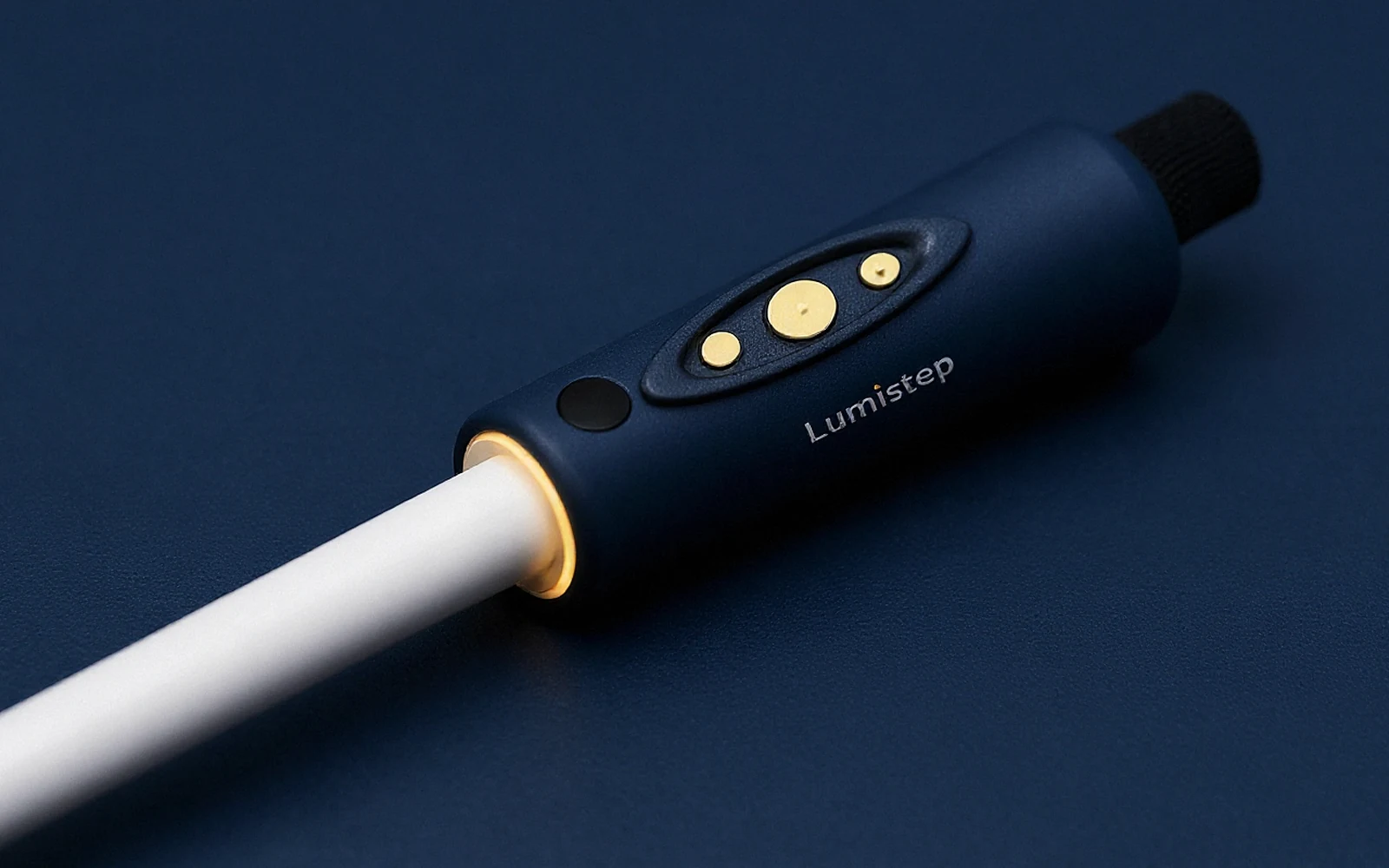
- Redesigned the cane’s controls. Domed buttons on top of the grip were rejected, because a gripping palm can press them while walking. The grip is now clear of controls. Three flush buttons, Talk, Call and SOS, sit about 1 mm below the raised rim of a shallow thumb pad, with a firm press of about 4 N and a clear click.
- What we learned
- A button you can find by touch is not the same as a button you can press by accident. Deliberate gestures matter as much as shape: hold Talk for half a second, double-press Call, and hold SOS for 3 seconds with a rising buzz, releasing to cancel. A swing lock ignores quick taps while the cane is moving.
- What’s next
- Test the pad with blind participants: can it be found quickly by touch, in gloves and in the cold, and does anything still trigger by mistake?
· Engineering
Prototype parts list and sourcing
In progress
- What we did
- Wrote the engineering prototype parts list for the cane, glasses and buds: a 60 GHz radar module[17], a time-of-flight laser[18], a Bluetooth low-energy controller with a motion sensor, left and right haptic motors, and the low-power Lumi Vision sensor[28]. Each key part has an established distributor and a backup.
- What we learned
- Some radar modules ship with presence-detection firmware and need re-flashing before they measure distance, and factory lead times on specialist sensors can run to months. Ordering early, and keeping a backup sensor in the plan, protects the field-trial date.
- What’s next
- Assemble the engineering prototypes and start measuring range, buzz timing and battery life against our targets.
· Industrial design
Industrial design concepts for the family
Done
- What we did
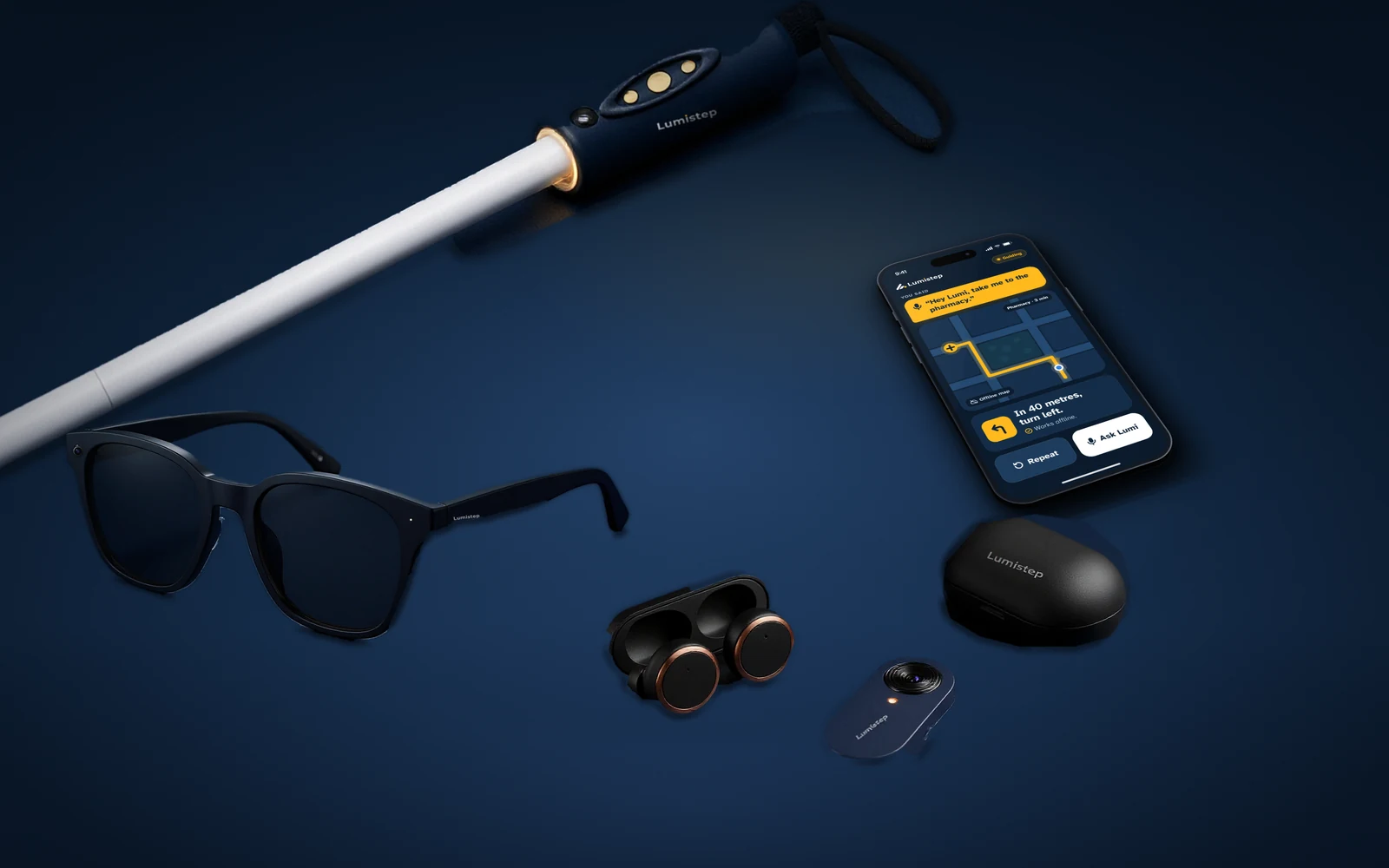
- Designed the three devices. The smart cane has a straight, sculpted navy handle, a sealed sensor lens for the radar, a downward laser window and the amber Lumi ring where the handle meets the folding shaft. The glasses are designer frames with the camera in the top outer corner and a privacy light opposite. The buds are tiny, with a coin-sized clip camera.
- What we learned
- Two findings shaped the family. Envision’s co-founder says smart glasses should not be a primary navigation tool[25], so the cane stays at the centre. And short battery life is a common complaint about smart canes, with the best-known one listing 6–8 hours of use[146], so our cane is designed for weeks between charges (target).
- What’s next
- Turn the concepts into engineering prototypes, then refine shape, weight and balance from field-trial feedback.
· Brand
Brand and design system complete
Done
- What we did
- Finished the name, logo, slogan, colours, type and the design system used across the website, documents and the app. Accessibility came first: clear type, AA contrast throughout, and the brand yellow used only on dark backgrounds.
- What we learned
- Brand yellow on white fails contrast checks, so “Lighting every step to independence.” only ever appears in yellow on navy. On the devices the brand stays quiet, a small mark, so people notice the person, not the product.
- What’s next
- Carry the system into the app’s screens and spoken prompts, and into packaging that can be opened by touch.
· Research
Research library and fact-check
Done
- What we did
- Gathered and checked the evidence behind every number we use: sight loss and its cost, access to assistive technology, smart canes, sensing, cameras and AI, privacy and safety. Every figure on this site links to its source in our research library.
- What we learned
- Prices and figures in this field go out of date quickly, and some widely repeated ones were already wrong. Rechecking them, and dating every comparison, is now part of how we work.
- What’s next
- Keep the library current, and add our own field-trial results when we have them, with the method alongside.
Designed in November 2026.
The smart cane, the glasses, the buds and the app. Next, they become engineering prototypes.
What comes next.
These have not happened yet. They are plans, with the dates we are working to. If a date moves, we will say so here.
Planned, February 2027
Field trials
- What we plan
- Paid co-design and field trials with blind and low-vision testers, mobility trainers and sight-loss charities.
- What we want to learn
- Whether the buzz language, thumb pad, sensing range and voice work for real people on real streets, and what we got wrong.
- What comes after
- Design changes, then another round of testing before anything is certified.
Planned, mid 2027
Certification
- What we plan
- Safety, radio and electrical testing for the markets where the first kits will be sold.
- What we want to learn
- What the test labs ask us to change, and how long each market takes.
- What comes after
- Final production design and tooling.
Planned, late 2027
First production kits
- What we plan
- The first production kits: the smart cane, glasses or buds, and the app.
- What we want to learn
- How kits perform day to day, at a scale no trial can reach.
- What comes after
- Training, support and sponsored kits through charities and public schemes.
No quiet changes.
An entry goes in when something real happens. Targets are called targets. When a plan changes, the old date stays visible and the new one sits beside it.
- Real milestones only
- No announcements of things that have not happened, and no partners named without their written permission.
- Dated
- Every entry has a date, and the page shows when it was last updated.
- Sourced
- Where an entry rests on outside research, it links to the source in our research library.
Be part of it.
People and families
Join the pilot list
Hear first about field trials from February 2027 and the first production kits.
Join the pilot listCharities, trainers and sponsors
Support Lumistep
Sponsor a kit, host a field trial or partner with us to reach the people who need it most.
Ways to supportInvestors
Invest in Lumistep
We are raising our first round to complete engineering and field trials.
For investors