
Prices checked November 2026
How Lumistep compares.
Side by side with seven products that blind and low-vision people can use or buy today. Every fact about them links to its source. Lumistep is planned, and not yet for sale.
A fair comparison.
A product still in engineering is being set against products people already own. That is not an even contest, and we do not pretend it is. Read the Lumistep column as a promise we still have to keep.
- Lumistep is planned and not yet available. Its column shows design targets and plans, not measurements.
- The others are shipping products, or for Glide a pilot, with real users, real support and years of learning behind them.
- “Not stated” does not mean “no”. It means the maker has not published it and we could not confirm it.
- Company figures are the maker’s own claims, such as battery life and range. We have not tested these products.
- Prices are as each seller lists them, in their own currency, without conversion.
Eight products. Six questions.
The short answers first. Every one is explained and sourced in the two detailed tables that follow.
| LumistepPlanned | WeWALK Smart Cane 2Smart cane | GlideWheeled guide robot | .lumen glassesHaptic guidance headset | Envision GlassesAI camera glasses | Ally Solos GlassesAI audio glasses with a camera | Ray-Ban Meta with Be My EyesMainstream AI camera glasses | OrCam MyEyeClip-on camera reader | |
|---|---|---|---|---|---|---|---|---|
| Price | $199 / £149 kit (planned) | US$850[147] | US$1,499 (sold out)[159] | €9,999[160] | US$1,899–3,499[35] | US$699[36] | From US$379[100] | From £2,700 ex VAT[150] |
| Obstacle sensing | Planned | Yes | Yes | Yes | No | No | No | No |
| Head height | Planned | Yes | Not stated | Not stated | No | No | No | No |
| Reading and description | Planned | No camera | Not stated | Not stated | Yes | Yes | Yes | Reads text |
| Works offline | Designed to | Not stated | Not stated | Not stated | Partly | Not stated | No | Yes |
| Status | Not yet available | On sale | Pilot; waitlist | Romania only | Ends 2026 unless a partner is found | Reported sold out | On sale widely | Development stopped 2024 |
A tick means yes, a dash means no, half a circle means partly. “Not stated” means the maker has not published it. The yellow dot marks a Lumistep plan.
Mobility aids.
Products that sense what is ahead or guide you along the way: a smart cane, a guide robot and a guidance headset.
| LumistepPlanned · not yet available | WeWALK Smart Cane 2WeWALK (UK / Türkiye) | GlideGlidance (US) | .lumen glasses.lumen (Romania) | |
|---|---|---|---|---|
| Price | Planned at $199 / £149 for a kit; the cane alone at $99. Safety and navigation stay free. Optional plans from $4.99 a month. | US$850 in the US[147]; £849 ex VAT at RNIB[146]. Launched with a US$4.99 a month AI assistant, or US$1,150 with no fee[21]. | Early pre-order price US$1,499, now sold out, plus a US$30 a month connectivity subscription[159]. | €9,999 including VAT[160]. |
| What it is | A smart cane, plus designer camera glasses or tiny earbuds with a clip camera, and an app. Use the cane alone or the full kit. | A smart handle on a folding white cane, with an obstacle sensor, vibration, voice navigation and an AI voice assistant[19]. | A self-guiding wheeled robot with a handle, which the maker calls an intelligent guide[159]. | A head-worn headset, sold as Glasses for the Blind, that works out a walkable path and guides you with haptic cues[160]. |
| Obstacle sensing | Yes, by design. A 60 GHz radar looks ahead[17], a downward laser checks for kerbs, steps and drops, and the handle buzzes left or right. | Yes. An ultrasonic sensor; the cane vibrates to warn[157]. | Yes. Two infrared stereo depth cameras that see about 50 ft (15 m) ahead[159]. | Yes. It computes the path ahead 100 times a second, company figure[160]. |
| Head-height detection | Yes, by design. The radar looks forward and up to head height, to about 3 m (target). | Yes. The maker’s manual describes obstacles between head and waist[157]. | Not stated | Not stated |
| Reading and scene description | Planned. Reads signs, letters and documents offline. Short scene descriptions offline; richer ones online. | No camera. An AI voice assistant answers spoken questions[21]. | Not stated | Not stated |
| Navigation | Planned. Walk with Lumi: offline turn-by-turn voice guidance, with a left or right buzz on the cane. | Yes. Turn-by-turn voice navigation[19]. | Guides you as you walk. More features are promised through over-the-air updates[159]. | Path guidance now. Route navigation and street crossing are listed as coming soon[160]. |
| Works offline | Designed for it. Sensing, reading and walking guidance work with no signal. Ask Lumi and helper calls need internet. | Not stated for navigation or the assistant. The maker says it still works as a lightweight cane when disconnected[19]. | Not stated. It has Bluetooth, Wi-Fi and LTE, with the data plan in the subscription[159]. | Not stated |
| Form factor | Folding smart cane (340–420 g in aluminium, target) with glasses (38–42 g, target) or buds (about 4 g each, target), and a phone app. | A handle on a folding cane. Handle 184 g; whole cane about 409–469 g, by length[146]. | A wheeled robot with a handle. 4 kg, IP54 weather resistance[159]. | A head-worn headset. Weight not stated[160]. |
| Battery | Targets: the cane about 3–6 weeks of daily walking; the glasses a full day; the buds 4–6 hours a charge. | 6–8 hours of use, 48 hours on standby, per the RNIB listing[146]. | 95 Wh; 6+ hours of active use (30,000+ steps), company figure[159]. | Not stated |
| Availability | Not available yet. In engineering development. Field trials from February 2027; first production kits planned for late 2027. | On sale. The maker says it is used in more than 60 countries[93]. | Small pilot rollout. New orders are closed; waitlist only[22]. | CE certified. Ships only to Romania, 3–6 months after order[160]. |
| Support model | Training with every kit, designed with orientation and mobility specialists. Safety features are never behind a plan; paid plans add AI time, a human helper and a longer warranty. | Sold direct and through sight-loss charities such as RNIB[146]. A 30-day trial and a 1-year warranty on its own site[19]; paid human help (WeASSIST) in some countries[158]. | A monthly subscription that includes the data plan; software updates over the air[159]. | A 24-month warranty[160]. |
Lumistep
Planned · not yet available
- Price
- Planned at $199 / £149 for a kit; the cane alone at $99. Safety and navigation stay free. Optional plans from $4.99 a month.
- What it is
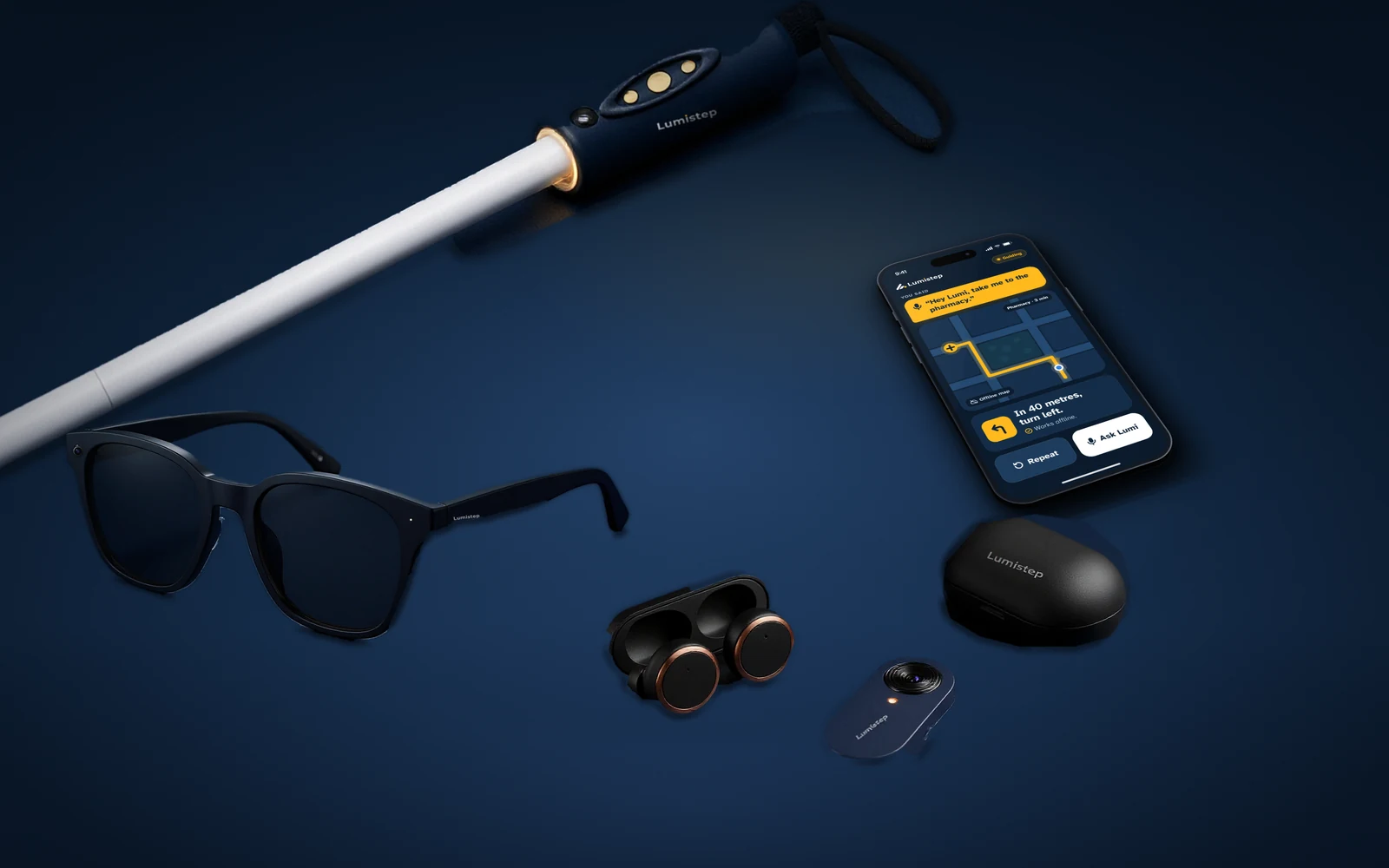
- A smart cane, plus designer camera glasses or tiny earbuds with a clip camera, and an app. Use the cane alone or the full kit.
- Works offline
- Designed for it. Sensing, reading and walking guidance work with no signal. Ask Lumi and helper calls need internet.
- Availability
- Not available yet. In engineering development. Field trials from February 2027; first production kits planned for late 2027.
All 11 details for Lumistep
- Obstacle sensing
- Yes, by design. A 60 GHz radar looks ahead[17], a downward laser checks for kerbs, steps and drops, and the handle buzzes left or right.
- Head-height detection
- Yes, by design. The radar looks forward and up to head height, to about 3 m (target).
- Reading and scene description
- Planned. Reads signs, letters and documents offline. Short scene descriptions offline; richer ones online.
- Navigation
- Planned. Walk with Lumi: offline turn-by-turn voice guidance, with a left or right buzz on the cane.
- Form factor
- Folding smart cane (340–420 g in aluminium, target) with glasses (38–42 g, target) or buds (about 4 g each, target), and a phone app.
- Battery
- Targets: the cane about 3–6 weeks of daily walking; the glasses a full day; the buds 4–6 hours a charge.
- Support model
- Training with every kit, designed with orientation and mobility specialists. Safety features are never behind a plan; paid plans add AI time, a human helper and a longer warranty.
WeWALK Smart Cane 2
WeWALK (UK / Türkiye) · On sale
- Price
- US$850 in the US[147]; £849 ex VAT at RNIB[146]. Launched with a US$4.99 a month AI assistant, or US$1,150 with no fee[21].
- What it is
- A smart handle on a folding white cane, with an obstacle sensor, vibration, voice navigation and an AI voice assistant[19].
- Works offline
- Not stated for navigation or the assistant. The maker says it still works as a lightweight cane when disconnected[19].
- Availability
- On sale. The maker says it is used in more than 60 countries[93].
All 11 details for WeWALK Smart Cane 2
- Obstacle sensing
- Yes. An ultrasonic sensor; the cane vibrates to warn[157].
- Head-height detection
- Yes. The maker’s manual describes obstacles between head and waist[157].
- Reading and scene description
- No camera. An AI voice assistant answers spoken questions[21].
- Navigation
- Yes. Turn-by-turn voice navigation[19].
- Form factor
- A handle on a folding cane. Handle 184 g; whole cane about 409–469 g, by length[146].
- Battery
- 6–8 hours of use, 48 hours on standby, per the RNIB listing[146].
Glide
Glidance (US) · Pilot
- Price
- Early pre-order price US$1,499, now sold out, plus a US$30 a month connectivity subscription[159].
- What it is
- A self-guiding wheeled robot with a handle, which the maker calls an intelligent guide[159].
- Works offline
- Not stated. It has Bluetooth, Wi-Fi and LTE, with the data plan in the subscription[159].
- Availability
- Small pilot rollout. New orders are closed; waitlist only[22].
All 11 details for Glide
- Obstacle sensing
- Yes. Two infrared stereo depth cameras that see about 50 ft (15 m) ahead[159].
- Head-height detection
- Not stated
- Reading and scene description
- Not stated
- Navigation
- Guides you as you walk. More features are promised through over-the-air updates[159].
- Form factor
- A wheeled robot with a handle. 4 kg, IP54 weather resistance[159].
- Battery
- 95 Wh; 6+ hours of active use (30,000+ steps), company figure[159].
- Support model
- A monthly subscription that includes the data plan; software updates over the air[159].
.lumen glasses
.lumen (Romania) · Limited
- Price
- €9,999 including VAT[160].
- What it is
- A head-worn headset, sold as Glasses for the Blind, that works out a walkable path and guides you with haptic cues[160].
- Works offline
- Not stated
- Availability
- CE certified. Ships only to Romania, 3–6 months after order[160].
All 11 details for .lumen glasses
- Obstacle sensing
- Yes. It computes the path ahead 100 times a second, company figure[160].
- Head-height detection
- Not stated
- Reading and scene description
- Not stated
- Navigation
- Path guidance now. Route navigation and street crossing are listed as coming soon[160].
- Form factor
- A head-worn headset. Weight not stated[160].
- Battery
- Not stated
- Support model
- A 24-month warranty[160].
Camera wearables.
Glasses and clip-on cameras that read text and describe the world. None of them senses obstacles at cane level, and their makers do not claim to.
| LumistepPlanned · not yet available | Envision GlassesEnvision (Netherlands) | Ally Solos GlassesEnvision with Solos | Ray-Ban Meta with Be My EyesMeta and EssilorLuxottica; Be My Eyes | OrCam MyEyeOrCam (Israel) | |
|---|---|---|---|---|---|
| Price | Planned at $199 / £149 for a kit; the cane alone at $99. Safety and navigation stay free. Optional plans from $4.99 a month. | US$1,899–3,499, by edition[35]. | US$699 with a year of Ally Pro[36]; launched at US$399[24]. After that, Ally Pro is US$10 a month[24]. | Gen 2 from US$379[100]; Gen 3 US$449[164]. Be My Eyes is free[101]. | £2,700 (MyEye Smart) to £3,700 (MyEye Pro), ex VAT, at RNIB[150]. |
| What it is | A smart cane, plus designer camera glasses or tiny earbuds with a clip camera, and an app. Use the cane alone or the full kit. | AI camera glasses that read text and describe what is in front of you[35]. | Audio glasses with a camera, running Envision’s Ally assistant, with the AI on a paired phone[162]. | Mainstream AI camera glasses. Be My Eyes is built in, for free video calls to sighted volunteers[101]. | A small camera that clips onto your own glasses and reads text aloud[165]. |
| Obstacle sensing | Yes, by design. A 60 GHz radar looks ahead[17], a downward laser checks for kerbs, steps and drops, and the handle buzzes left or right. | No. | No. | No. | No. |
| Head-height detection | Yes, by design. The radar looks forward and up to head height, to about 3 m (target). | No. | No. | No. | No. |
| Reading and scene description | Planned. Reads signs, letters and documents offline. Short scene descriptions offline; richer ones online. | Yes. Reading and description are its main jobs[35]. | Yes. Reads and describes through a conversation with Ally[24]. | Yes. Meta AI reads and describes, and a volunteer can look through the camera[58]. | Yes. Reads printed text aloud[165]. |
| Navigation | Planned. Walk with Lumi: offline turn-by-turn voice guidance, with a left or right buzz on the cane. | Not a primary navigation tool, in its co-founder’s own words[25]. | Not stated | Not reliable for navigation and no replacement for a white cane, says the American Foundation for the Blind[58]. | Not stated |
| Works offline | Designed for it. Sensing, reading and walking guidance work with no signal. Ask Lumi and helper calls need internet. | Partly. Envision plans a final update so the app keeps working offline for as long as possible[10]. | Not stated. The AI runs on the paired phone[162]. | No. Needs a phone and an internet connection[100]. | Yes. Processing happens on the device; internet is needed only for updates, company figure[165]. |
| Form factor | Folding smart cane (340–420 g in aluminium, target) with glasses (38–42 g, target) or buds (about 4 g each, target), and a phone app. | Glasses with a built-in camera. Weight not stated. | Glasses, about 42 g[162]. | Ordinary-looking glasses, paired with a phone. | A clip-on camera for glasses you already own. |
| Battery | Targets: the cane about 3–6 weeks of daily walking; the glasses a full day; the buds 4–6 hours a charge. | Not stated | 15+ hours of active use, company figure[161]. | Gen 2: up to 8 hours of typical use, company figure[163]. | Not stated |
| Availability | Not available yet. In engineering development. Field trials from February 2027; first production kits planned for late 2027. | Envision will stop product development at the end of 2026 unless it finds a partner[10]. | Reported sold out with no restock date[162]. Its future depends on Envision[10]. | On sale widely. More than 7 million Ray-Ban and Oakley Meta glasses were sold in 2025[144]. | Still listed, but OrCam stopped developing low-vision devices in 2024[11]. |
| Support model | Training with every kit, designed with orientation and mobility specialists. Safety features are never behind a plan; paid plans add AI time, a human helper and a longer warranty. | Long-term support depends on Envision finding a partner[10]. | An Ally Pro subscription after the first year[36]. | Mainstream retail and Meta support. Be My Eyes has more than 10 million volunteers[131]. | Dealers and distributors. The maker promises continued support and app updates[166]. |
Envision Glasses
Envision (Netherlands) · Winding down
- Price
- US$1,899–3,499, by edition[35].
- What it is
- AI camera glasses that read text and describe what is in front of you[35].
- Works offline
- Partly. Envision plans a final update so the app keeps working offline for as long as possible[10].
- Availability
- Envision will stop product development at the end of 2026 unless it finds a partner[10].
All 11 details for Envision Glasses
- Obstacle sensing
- No.
- Head-height detection
- No.
- Reading and scene description
- Yes. Reading and description are its main jobs[35].
- Navigation
- Not a primary navigation tool, in its co-founder’s own words[25].
- Form factor
- Glasses with a built-in camera. Weight not stated.
- Battery
- Not stated
- Support model
- Long-term support depends on Envision finding a partner[10].
Ally Solos Glasses
Envision with Solos · Sold out
- Price
- US$699 with a year of Ally Pro[36]; launched at US$399[24]. After that, Ally Pro is US$10 a month[24].
- What it is
- Audio glasses with a camera, running Envision’s Ally assistant, with the AI on a paired phone[162].
- Works offline
- Not stated. The AI runs on the paired phone[162].
All 11 details for Ally Solos Glasses
- Obstacle sensing
- No.
- Head-height detection
- No.
- Reading and scene description
- Yes. Reads and describes through a conversation with Ally[24].
- Navigation
- Not stated
- Form factor
- Glasses, about 42 g[162].
- Battery
- 15+ hours of active use, company figure[161].
- Support model
- An Ally Pro subscription after the first year[36].
Ray-Ban Meta with Be My Eyes
Meta and EssilorLuxottica; Be My Eyes · On sale
- What it is
- Mainstream AI camera glasses. Be My Eyes is built in, for free video calls to sighted volunteers[101].
- Works offline
- No. Needs a phone and an internet connection[100].
- Availability
- On sale widely. More than 7 million Ray-Ban and Oakley Meta glasses were sold in 2025[144].
All 11 details for Ray-Ban Meta with Be My Eyes
- Obstacle sensing
- No.
- Head-height detection
- No.
- Reading and scene description
- Yes. Meta AI reads and describes, and a volunteer can look through the camera[58].
- Navigation
- Not reliable for navigation and no replacement for a white cane, says the American Foundation for the Blind[58].
- Form factor
- Ordinary-looking glasses, paired with a phone.
- Battery
- Gen 2: up to 8 hours of typical use, company figure[163].
- Support model
- Mainstream retail and Meta support. Be My Eyes has more than 10 million volunteers[131].
OrCam MyEye
OrCam (Israel) · Still listed
- Price
- £2,700 (MyEye Smart) to £3,700 (MyEye Pro), ex VAT, at RNIB[150].
- What it is
- A small camera that clips onto your own glasses and reads text aloud[165].
- Works offline
- Yes. Processing happens on the device; internet is needed only for updates, company figure[165].
- Availability
- Still listed, but OrCam stopped developing low-vision devices in 2024[11].
All 11 details for OrCam MyEye
Lumistep’s planned details are in the first block of the mobility aids section above.
Where others lead, and what we add.
Lumistep is not trying to replace the tools people rely on. It is aimed at a gap none of them fills on its own.
Where others lead today
- They are real. WeWALK, Ray-Ban Meta and OrCam are on sale now, and Glide is in a pilot[22]. Lumistep has nothing to sell yet.
- Ray-Ban Meta looks ordinary, costs far less than specialist glasses and has Be My Eyes built in, with more than 10 million volunteers[131].
- OrCam already reads text with no internet connection[165].
- WeWALK sells through sight-loss charities, with a trial and a warranty[19].
- Glide guides you physically as you walk, a different approach from a cane[159].
What Lumistep is designed to add
- Cane-level sensing and a camera wearable in one kit. Today they are separate purchases.
- A planned price of $199 / £149 for the kit, against US$850 for the best-known smart cane alone[147].
- Offline by design for safety sensing, reading and walking guidance.
- Weeks of cane battery as the target, where the best-known smart cane lists 6–8 hours of use[146].
- Still a normal white cane if the battery runs out, and built to sit alongside tools people already use, such as Be My Eyes and their phone’s screen reader.
Dated, sourced, open to correction.
Prices and facts were last checked on 20 November 2026. This market changes month to month, so we recheck it and change the date when we do.
- Sources
- Makers’ own product and support pages, charity and retail listings, and named press. Each fact links to its entry in our research library.
- Prices
- As each seller lists them, in their currency, without conversion. Where a price is before or after tax, we say which.
- Not stated
- Used when a maker has not published a fact and we could not confirm it elsewhere. We would rather leave a gap than guess.
- Company figures
- Battery life, ranges and user counts come from the companies themselves and are labelled that way.
- Lumistep
- Our column shows design targets and plans. Field trials with blind participants from February 2027 will set the real numbers.
Be part of it.
People and families
Join the pilot list
Hear first about field trials from February 2027 and the first production kits.
Join the pilot listCharities, trainers and sponsors
Support Lumistep
Sponsor a kit, host a field trial or partner with us to reach the people who need it most.
Ways to supportInvestors
Invest in Lumistep
We are raising our first round to complete engineering and field trials.
For investors